
Ottawa County Court Records After Arrest
After a jail arrest in Ottawa County, the custody record and the court record are related but not the same. Booking happens at the jail. The criminal case begins when the Ottawa County Attorney decides what charges to file and the district court opens or updates a public case record. The booking label may be broad or preliminary, while the court record should show the prosecutor's filed charge, case number, hearings, bond orders, and later disposition if the record is public.
Use jail inmate records for current custody, booking, release, or transfer questions. Use jail roster mugshots for booking-photo requests. Court records after a jail arrest belong in the district court path, where filed charges, hearings, warrants, and outcomes are tracked.
Find Ottawa County Court Records
Ottawa County criminal cases are handled by Ottawa County District Court in the 28th Judicial District. The official district court page lists the court at 307 N. Concord in Minneapolis, with public counter hours Monday through Friday, 8:00 AM to 5:00 PM, closed from noon to 1:00 PM. The district court administration page lists judges, the clerk, and court staff. The statewide search path is Kansas CaseSearch, which replaced the older public access portal referenced on some county pages.
- Open Kansas CaseSearch and accept the portal terms if prompted.
- Search by record number or defendant name, using spelling variants when needed.
- Open the public case and review the charge list, party names, hearings, warrants, and docket events.
- Contact the Ottawa County District Court clerk at 785-392-2917 for older, sealed, not-yet-indexed, or courthouse-terminal records.
The Kansas Judicial Branch district court records page explains that some records are available through the portal, some are available at courthouse terminals, and sealed cases are not public. A name or case number is the most useful starting point.
If the arrest is very recent, the court case may not appear yet. The jail can confirm custody before the prosecutor files charges, while CaseSearch becomes useful after the charging document reaches the court. For urgent bond or court-date questions, use both the jail and the district court clerk because each office controls a different part of the process.
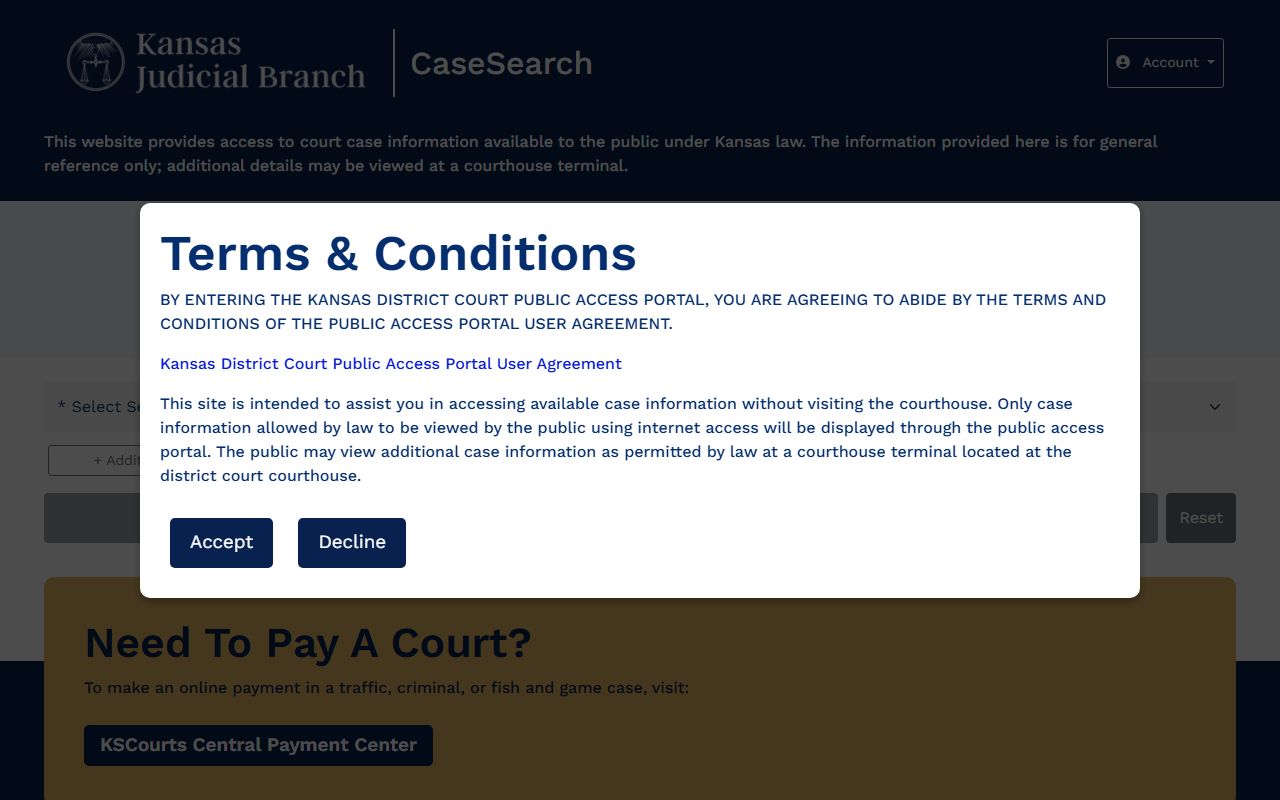
The statewide portal screenshot shows the correct court-record search channel after an Ottawa County arrest has moved into filed charges.
Ottawa County Court Search Fields
Kansas Smart Search is name or record-number driven. Role-based access can change the criteria shown to different users, but the public search path still starts with a defendant name or case number. The Judicial Branch Smart Search guide is the source for the name-or-record-number requirement. Traffic citations can also be searched when the arrest or court event came from a citation-based case.
| Field Label | Type | Required | Notes |
|---|---|---|---|
| Case number / Record number | Text | One of name or number required | Kansas Smart Search says a record number or name is required. |
| Name / Party name | Text | One of name or number required | Search by defendant or party name. |
| Business name | Text | Optional | Less common for criminal arrest follow-up. |
| Citation | Text | Optional | Useful for traffic or citation cases. |
| Role-based criteria | Varies | Optional | The portal states criteria vary by role and access level. |
Charges Filed After an Arrest
The Ottawa County Attorney is the prosecutor for local criminal cases. The county attorney page lists County Attorney Jeffrey Ebel at 307 N. Concord, Suite 206, with phone 785-392-2953 and attorney@ottawacounty.org. That office decides what charges to file after a jail arrest. The court file may begin with a complaint or other charging document, and the filed charge may differ from the arresting-agency booking label.
| Document | Who Uses It | What It Does |
|---|---|---|
| Complaint | Prosecutor or officer-supported filing | Starts a criminal case by setting out the charge allegations. |
| Information | Prosecutor | States formal charges, often in felony cases after the prosecutor reviews facts. |
| Indictment | Grand jury | Formal accusation returned by a grand jury in cases where that process is used. |
Ottawa County Charge Status
Court records after an arrest can change as a case moves. A charge may be pending at first appearance, amended after review, reduced through plea talks, dismissed by the court, or resolved by conviction or diversion. Do not treat a booking charge as a conviction. A booking charge is an intake label. A conviction is a final court outcome after plea, verdict, or other qualifying disposition.
CaseSearch should be read by event date and charge status, not just by the first charge line visible. A later docket entry may show a bond review, amended complaint, warrant recall, plea, diversion, dismissal, or sentencing order. When the portal text is unclear, the district court clerk is the better source for public case-record access.
| Status | What It Means |
|---|---|
| Pending | The charge is filed and the case is still open. |
| Amended | The filed charge changed after prosecutor or court action. |
| Reduced | The charge level or offense was lowered, often through court order or plea process. |
| Dismissed | The charge is no longer being pursued in that case. |
| Convicted | The person was found guilty or entered a guilty or no-contest plea accepted by the court. |
Bond After Ottawa County Arrest
Kansas release conditions are governed mainly by K.S.A. 22-2802. Conditions can include cash bond, surety bond, recognizance release, supervision, travel limits, no-contact orders, treatment or evaluation, house arrest, or other public-safety and appearance terms. Ottawa County did not publish a bond desk, local payment portal, bail schedule, or accepted payment methods, and the district court filing-fee page lists docket fees rather than bond amounts, so the jail and court should be called before travel.
| Bond Term | Plain Meaning |
|---|---|
| Cash bond | Money deposited as ordered by the court or jail process. |
| Surety bond | A bond posted through an approved surety or bonding arrangement. |
| Recognizance | Release based on a promise to appear without a cash deposit. |
| No-bond hold | A hold or court order prevents ordinary release. |
| Detainer | Another agency or jurisdiction has placed a hold that may block release. |
Warrants and Ottawa County Arrest
No official Ottawa County active warrant list or sheriff warrant database was located. For warrant-related court records after an arrest, use the sheriff's office for local custody and warrant status, the district court clerk for bench warrants tied to public court files, and Kansas CaseSearch for related cases. KASPER can help when the issue is state supervision or a parole absconder. Federal warrant routing belongs with official federal channels, not local rumor lists.
A bench warrant can appear in a court case even when a person is not currently in the Ottawa County jail. A jail hold can also exist before a public docket is easy to find. That is why warrant questions should be checked through the sheriff and the court, with each office asked only for the records it controls.
Warrant types include arrest warrants, bench warrants for failure to appear, probation or parole violation warrants, search warrants, and fugitive or out-of-county warrants. A warrant may produce a booking at Ottawa County Detention Center, but the public court record may not appear until filing or docket activity occurs. For safety, no one should try to detain another person based on a warrant rumor.
Charges vs Convictions
A charge is an accusation in a court case. A conviction is a final outcome. Ottawa County court records after a jail arrest can show both, depending on case stage, but the terms should not be mixed. This distinction matters for employment forms, housing forms, licensing, and personal background checks.
| Point | Charge | Conviction |
|---|---|---|
| Case stage | Filed accusation after arrest or investigation. | Final result after plea, verdict, or qualifying disposition. |
| Proof level | Not proof of guilt. | Reflects court finding or accepted plea. |
| Can change? | Yes, it may be amended, reduced, or dismissed. | May later be appealed, corrected, or expunged if eligible. |
Sealed and Expunged Records
K.S.A. 21-6614 governs expungement of certain Kansas convictions, arrest records, and diversion agreements. Expungement is not the same as a private website removal request. It is a court process. Eligibility depends on the offense, outcome, waiting period, and statutory limits. When a record is sealed or expunged, public access can change even if older indexes or copies once existed.
| Record Status | Public Effect | Important Limit |
|---|---|---|
| Public | Available through portal, terminal, or clerk request if not exempt. | Some details can still be redacted. |
| Sealed | Hidden from ordinary public access. | Law or court order may allow limited access. |
| Expunged | Treated as cleared for many public purposes under Kansas law. | Not automatic, and exceptions can apply. |
Restricted Ottawa County Court Records
Kansas public-record law allows access to many court and jail records, but it also has limits. Juvenile records, sealed cases, medical or mental-health information, confidential victim details, security-sensitive material, and criminal-investigation records can be withheld or redacted. K.S.A. 45-221 is the main exemption statute cited in the research for jail and investigation limits.
The Kansas Judicial Branch court-records request page explains public court records under KORA. If CaseSearch does not show a record, that does not prove no arrest happened. The case may not be filed yet, may be sealed, may be indexed under a different name, or may require courthouse-terminal or clerk assistance. For statewide criminal-history research outside the court docket, the Kansas criminal history search is a separate fee-based KBI/Kansas.gov channel.
Important: Court records after arrest are public-record references, not consumer reports for FCRA-covered decisions.